A new research article has just been published in Analytical Chemistry, a leading journal of the American Chemical Society (ACS), authored by PhD researcher Aida López Espinar in collaboration with Marama Labs team, and supervised by Professor Piotr Kowalski, School of Pharmacy, University College Cork.
The study presents a significant step forward in solving a long-standing prevailing challenge in RNA-based drug development: accurately measuring RNA inside complex nanoparticle delivery systems.
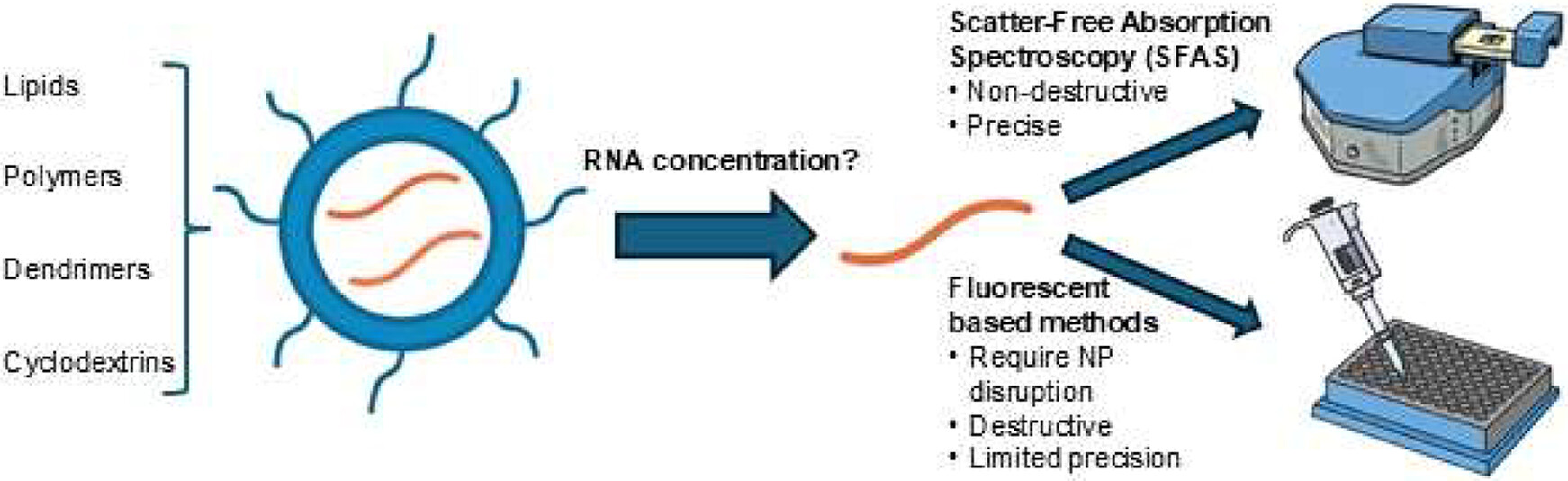
RNA therapeutics are rapidly gaining momentum for treating a wide spectrum of diseases, but researchers still struggle to quantify how much RNA is truly present in nanoparticle formulations. Traditional fluorescence-based methods, such as RiboGreen assays, require nanoparticles to be opened so dyes can bind to the RNA. Many nanoparticle systems are difficult to disrupt, leading to incomplete release of RNA and inaccurate measurements.
The newly published study evaluates Scatter-Free Absorption Spectroscopy (SFAS) — a UV/Visible spectroscopy method which removes the light-scattering interference caused by intact nanoparticles. Crucially, SFAS allows researchers to measure total RNA concentration without needing to break open the nanoparticles and by isolating the true RNA absorbance signal from scattering “noise.”
The team validated the method across Lipid nanoparticles (LNP), polymer–lipid hybrid nanoparticle (PH) system, cyclodextrin-based nanoparticles (CD), and other complex formulations. Across all cases, SFAS demonstrated superior accuracy, precision, and reproducibility compared with traditional fluorescent assays.
Read the full research article in the link below.